Key Takeaways
- Chocolate looks the worst and cleans the easiest. Let it harden, scrape, then blot with cold water only — hot water cooks the milk protein into the fiber.
- Face paint is two stains at once: a grease or wax base plus color. Break the grease first, then treat the color. Do it in the other order and you spread both.
- Fake blood's corn syrup rinses right out. The red dye is what stays, and dish soap alone will not move it.
- Blot, never rub. Rubbing drives the stain past the fiber into the backing, where no home method reaches it.
- Most Halloween spills need nothing but a white towel, cold water, and ten minutes. Professional carpet cleaning runs $100 for one area and $180 for two (minimum $180, or $220 inside Chicago) when a stain is genuinely set, spread, or sitting on wool.
The First Ten Minutes Decide Everything
"My son stepped on a fun-size Milky Way in the doorway and then walked to the couch."
That is close to a word-for-word transcript of the calls we take on the first of November. Halloween does not produce one stain. It produces a trail of them, in three or four different chemistries, usually found in the dark, usually after someone has already attacked one with a wet paper towel.
Here is the part that matters most, and it costs nothing: for the first several minutes, almost every Halloween stain is still sitting on top of the fiber. It has not bonded yet. What turns a ten-minute cleanup into a stain removal service call is rarely the spill — it is the wrong first move.
So before you touch anything, sort the mess. Solid or liquid? Greasy or watery? Colored or clear? Those three questions decide your method, and they explain why one all-purpose carpet spray performs so inconsistently on Halloween night. You are fighting a protein stain, a grease stain, and a dye stain at once, and they want opposite things from you.
One universal rule before the specifics: work from the outside edge of the stain inward. Starting in the middle pushes the stain outward and turns a coaster-sized spot into a dinner-plate-sized one. And if you would rather buy a product than mix your own, look for the Carpet and Rug Institute's Seal of Approval — the CRI calls it the carpet industry's only scientific program for testing whether a cleaning product actually works without damaging the carpet.
Chocolate: Looks Worst, Cleans Easiest
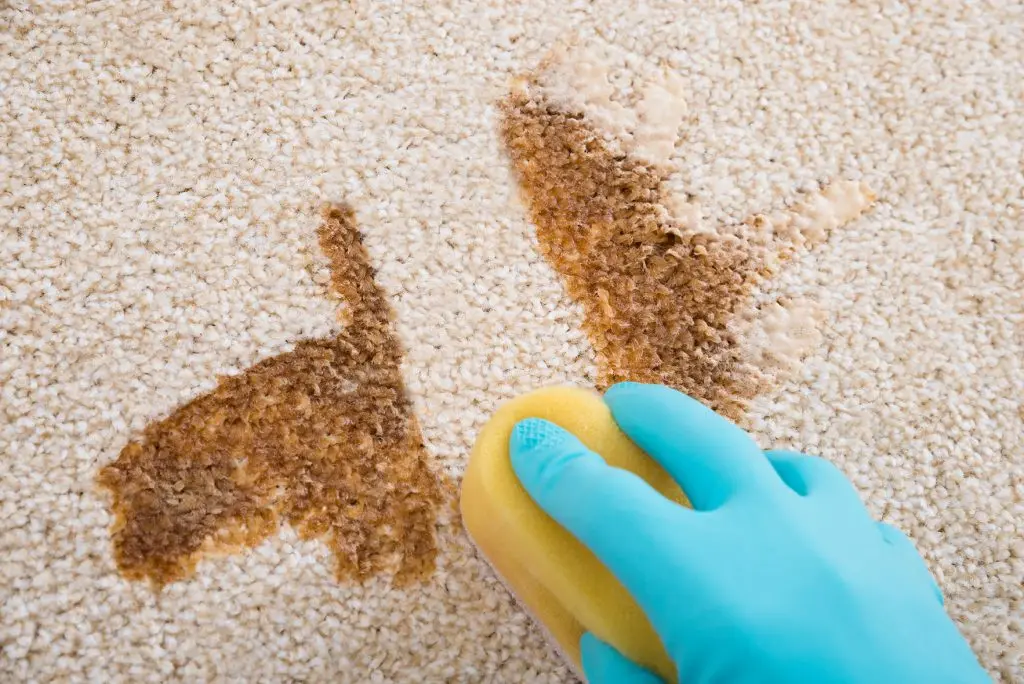
Melted chocolate ground into a light carpet is the most alarming thing you will see all night, and very often the least serious. It is a compound stain — cocoa solids, milk protein, sugar, cocoa butter — but every component is manageable if you do not apply heat.
Put an ice cube in a sandwich bag on the smear and let it go hard and brittle. Then lift the solid off with a spoon edge or dull butter knife, scraping toward the center rather than smearing outward. Most of the mass comes away dry, with no chemistry at all.
What is left is a brown shadow. Mix a quarter teaspoon of clear dish soap into a cup of cold water, wet a white cloth, and blot from the outside in, switching to a clean section of cloth as soon as it picks up color. Blot again with plain cold water to rinse the soap out, then weight a stack of paper towels on the spot for a couple of hours to draw moisture out of the backing.
The one mistake that ruins it is hot water. Heat denatures the milk protein and locks it into the fiber the same way it sets an egg in a pan. Once that happens no home method reverses it, and the spot becomes a job for professional carpet cleaning with proper extraction.
Face Paint: Grease and Dye, Two Problems in One
Face paint is where most people lose the carpet, and it is because they treat it as one stain when it is two.
Halloween makeup is pigment suspended in a grease, wax, or oil base. That base is what makes it cling to skin and resist sweat, and it is also why water-based cleaning fails on it — a wet cloth just floats the color around and widens the stain. The color is not dirt either. It is a color additive chosen to be vivid and stable; the FDA's Halloween safety guidance even tells consumers to check that vibrantly colored Halloween makeup uses approved color additives. Those pigments are engineered to stay put. On a face that is the point. On carpet it is the problem.
So work in order. Grease first. Scrape off any raised waxy deposit with a spoon, then put a little rubbing alcohol or a solvent spot cleaner on a white cloth — on the cloth, never poured onto the carpet — and blot. Test a hidden patch first, in a closet or under a sofa. You should see the greasy body of the stain transfer to the cloth.
Only then chase the color, with cold water and a drop of dish soap, blotting edge-inward and changing cloth sections constantly. Expect it to take longer than chocolate did. A sofa arm follows the same order, but fabric matters far more there — if the tag reads S, or there is no tag, stop and get upholstery cleaning rather than experiment. For a single face-paint mark on an otherwise clean couch, upholstery spot treatment is the cheaper call.
Fake Blood: The Corn Syrup Isn't the Problem
People panic about fake blood and treat the wrong half of it.
Most theatrical blood is corn syrup, thickener, and water. That part is sugar, and sugar is water-soluble — caught wet, nearly all of it blots out with cold water. What stays is the red dye, and dye is a different animal. Detergent lifts soil off fiber; it does not break a colorant that has bonded to it.
Blot every bit of liquid first, pressing straight down through a folded white towel and standing on it if you have to. Do not scrub. Then flush with small amounts of cold water and keep blotting until the towel stops taking up red.
For the color that remains, hydrogen peroxide is the usual home answer and it genuinely works — but peroxide lightens carpet as readily as it lightens a stain. Test somewhere invisible, use it sparingly, and never on wool. A pale ring where the stain used to be is the worse outcome.
Worth knowing: fake blood left overnight is a genuinely hard stain, not merely a stubborn one. Set into a light-colored or wool carpet, home attempts mostly succeed at spreading it into a pink halo.
Candy, Slime, and Candle Wax
The headline stains get the attention, but the rest of the night does real damage too.
Hard candy and lollipops are the easiest thing here: sugar and water, nothing more. Warm water dissolves them, blot dry, done. The catch is that leftover sugar stays tacky and grabs soil for weeks, so rinse more thoroughly than feels necessary.
Slime and putty want the freezer treatment — ice it solid, then break and pick the pieces out. Wiping slime while it is soft only works it deeper into the pile.
Candle wax from a jack-o'-lantern gets the reverse. Crack off what you can, then lay a plain brown paper bag over the rest and run a warm iron briefly over it so the wax wicks into the paper. Keep the iron moving and on low, and never let it touch carpet directly — synthetic fiber melts.
Costumed pets deserve a line of their own, because a dog in a costume is a stressed dog, and a stressed dog with a doorbell ringing forty times has accidents. That is not a Halloween stain at all — it soaks into the pad and the odor returns every humid day until the source is treated. It needs enzyme-based pet stain removal, not spot cleaner.
Five Things That Turn a Spill Into a Permanent Stain
Nearly every unsalvageable stain we are called out to see was made worse by one of these five.
- Rubbing instead of blotting. Rubbing does two irreversible things: it drives the stain below the fiber into the backing, and it abrades the fiber itself so that patch stays dull forever, even after the color is gone.
- Hot water on chocolate or anything with protein. It sets the stain. This is the one that most often converts an easy job into an impossible one.
- Water on face paint. Grease does not dissolve in water. All you do is spread it.
- Colored towels. A red dish towel on a wet carpet transfers its own dye. Use white cloths only, every time.
- Over-wetting. Saturating the spot pushes the stain into the pad, and the moisture reappears later as a ring or a musty smell.
If you are unsure how to start on any spill, the general sequence we use on every stain type is laid out in our guide to the first carpet stain steps.
When You Don't Need to Call Anyone
We would rather tell you this plainly than sell you something you do not need.
If the spill is fresh, the carpet is synthetic (nylon, polyester, or olefin — most carpet installed in Chicago-area homes in the last thirty years), the stain is smaller than your hand, and you caught it before it dried, you do not need a professional. Follow the method for that stain type and it will come out. Paying someone to do what a towel and cold water will do is a waste of your money.
You also do not need us for one spot in a room that was cleaned recently. If the rest of the room does not need attention, treat the spot yourself and put the money toward the whole-room clean when it is actually due.
Call when the stain has dried and set, when it has spread past hand-size, when it is on wool or silk or a rug you cannot identify, when a home attempt has left a ring or a lightened patch, or when the smell returns after the visible stain is gone — that last one means it reached the pad. To see what a whole-room job would run first, our cleaning cost calculator gives you a number without a phone call.
What It Costs When You Do
Our residential carpet cleaning is $100 for one area (up to 300 sq ft), $180 for two areas, and $50 for each additional area, with a $180 appointment minimum ($220 inside Chicago). We give free estimates so you know the number before we start rather than after. Upholstery cleaning — the costume-night couch, the armchair that took the face paint — is $130 for a sofa, $100 for a loveseat and $40 for a chair. Area rugs are priced by size at $1.50 per square foot in-home, or from $3 per square foot hand-washed at our plant, and pickup and delivery are free, which matters if the stain landed on a rug you would rather not roll into your own car.
We have worked Chicago and the North Shore since 1998 out of Northbrook, licensed and insured, and every job is backed by our satisfaction guarantee — which in practice means a Halloween stain we could not remove is a job you do not pay for. That guarantee is exactly why we tell people to try the free fixes first: we would rather you keep the $100 and call when something genuinely needs equipment. The IICRC, which describes its role as setting the global standard for cleaning and restoration, writes the standards our trade works to, and the honest reading of them is that plenty of fresh spills are homeowner work.
What justifies the truck is extraction depth. A home blot removes what sits in the top of the pile; hot water extraction pulls residue out of the base of the fiber and the backing, where a set stain and its smell actually live. Same reason a dried red wine stain removal job needs equipment rather than another round of towels. If you cannot tell which category your stain falls into, send us a photo and we will tell you honestly whether it is worth a visit — free estimate, no pressure either way.
Your Halloween Night Checklist
- Put a stack of white cloths and a roll of paper towels somewhere you can reach in the dark.
- Keep a spoon or dull knife handy for lifting solids — scraping removes more than any liquid will.
- Use cold water on chocolate, candy, and fake blood. No exceptions.
- Use a solvent on a cloth for face paint, and break the grease before you chase the color.
- Blot from the outside edge inward, and change to a clean part of the cloth constantly.
- Test any solvent, peroxide, or store-bought product on a hidden patch first.
- Never rub, never use a colored towel, never over-wet the spot.
- Weight paper towels down on the damp area afterward to draw moisture out of the backing.
- If the smell returns after the stain is gone, it reached the pad — stop and call.
- Bookmark our broader carpet stain removal tips for everything the costumes did not cause.
FAQ: Halloween Carpet Stains
How do you get chocolate out of carpet after Halloween?
Let the chocolate harden first, then lift the solid off with a spoon or a dull knife. Blot the remaining smear with cold water and a small amount of clear dish soap, working from the outside of the stain inward. Never use hot water, because chocolate contains milk protein and heat sets protein permanently into carpet fiber.
Does face paint come out of carpet?
Usually yes, but it takes two steps because face paint is pigment suspended in a grease or wax base. Break the grease first with a solvent-type spot cleaner or a little rubbing alcohol on a white cloth, then treat the color that is left behind. Treating the dye first just spreads the grease and makes the stain wider.
Will fake blood stain carpet permanently?
The corn syrup in fake blood rinses out easily with cold water. The red dye is the part that stays, and ordinary detergent will not move it. Blot up as much liquid as you can immediately, then treat the remaining color as a dye stain. Fake blood left overnight on wool or on a light carpet often needs professional treatment.
How much does professional carpet stain removal cost near Northbrook?
My Carpet Cleaning charges $100 for one area (up to 300 sq ft), $180 for two areas, and $50 for each additional area, with a $180 appointment minimum ($220 inside Chicago), and estimates are free. Upholstery cleaning is $130 for a sofa, $100 for a loveseat and $40 for a chair. We are based in Northbrook and serve Chicago and the surrounding suburbs, and you can see our full Northbrook carpet cleaning coverage on our service page.