The short answer
Yes, a jute rug can be cleaned professionally, but not the way carpet is. Jute is a plant fiber. Soak it and it can turn brown, shrink, or ripple. So on this job we did not wash the whole rug. (A wool or synthetic rug would have gone to our plant for a full hand wash; jute gets spot work in the home.) We worked only on the stained spots with as little moisture as possible, and kept air moving over the rug until it was dry. Two throw pillows from the same room were cleaned on the same visit. The bill was $220.
| Where | A living room in Barrington, IL (60010) |
| When | Tuesday, September 1, 2026, 12–2 PM arrival window |
| The rug | Large natural jute area rug with a tight basket weave, laid over hardwood |
| The problem | Dark organic stains in the middle of the rug, between the chair and the ottoman |
| Also cleaned | 2 throw pillows |
| Finished | 2:55 PM, about an hour after the technician headed out |
| Price | $220, one line item, nothing added on site |
What did the homeowner call about?
It started like a lot of our calls do: "I have a jute rug, it has stains, and I'm afraid to touch it." That fear is reasonable. Most people have heard that jute and water do not mix, and most have also seen what happens when someone tries anyway.
The rug sits in the main seating area of the living room. It has a sofa on one side, an upholstered armchair and a big tufted ottoman on top, and hardwood floor all around it. Over time a few dark patches had built up across the middle of the rug, right where people walk between the chair and the ottoman, put down drinks, and set down plates. While we were booked, the homeowner added two throw pillows from the same room.
Barrington is close to home for us. Our office is at Barrington Commons, so this was a short drive. If you are nearby, our page on carpet cleaning in Barrington lists everything we do in town, including free rug pickup.
Can you even clean a jute rug with water?
Barely, and carefully. That is the whole story of this job.
Jute comes from the stalk of a plant. Like cotton and other plant fibers, it contains natural compounds that move when the fiber gets wet. If a jute rug stays damp for a long time, those compounds travel to the tips of the fibers as the water evaporates and leave yellow-to-brown marks. The industry calls this cellulosic browning. The frustrating part is that the rug can look fine while it is wet, and the brown shows up only once it dries.
Too much water causes other problems too. Jute can shrink and ripple, the backing can stretch, and a rug that dries slowly on top of a hardwood floor is not good for the rug or the floor. Jute fibers are also brittle compared to wool or nylon. Scrub hard and they split and fuzz.
Cleanfax, a trade magazine for professional cleaners, sums up why jute rugs are hard to clean. They hold onto stains and odors, they do not stand up to aggressive cleaning, and they brown when they get too wet. Our approach starts from the same facts. For a wool, synthetic, or Oriental rug that needs a full wash, our area rug cleaning is done off-site in a controlled drying room. For a jute rug with a few problem spots, cleaning only the spots in your home is usually the safer option and costs less.
What did the rug look like when we walked in?
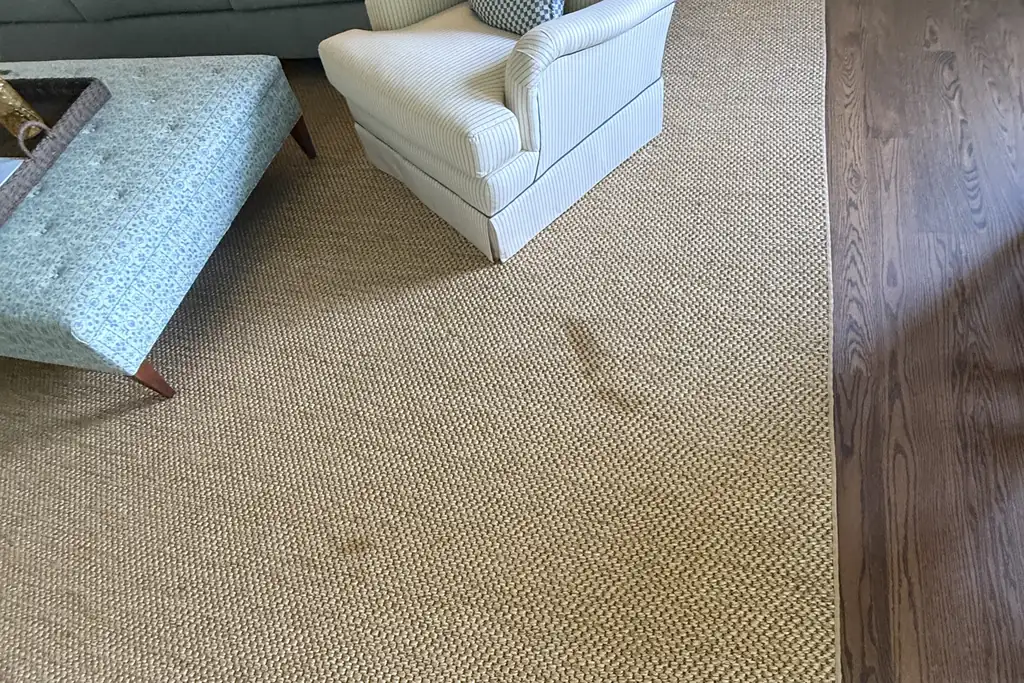
This is the rug before we started. The darker patches in the middle of the weave are the stains: a few separate spots, one longer smear, and some general shadowing where feet and furniture meet the rug. The rest of the rug was in good shape. It was a little dusty, but there was no overall dinginess that would have meant a full cleaning.
These were organic stains, the term for anything that came from something living: coffee, tea, wine, juice, food, mud, pet accidents. Organic stains on plant fiber need a different approach than oily ones. Strong alkaline cleaners, which work well on greasy soil in synthetic carpet, are exactly what pushes jute toward browning. So the cleaning solution matters as much as the technique. This is the same thinking behind our carpet and upholstery stain removal service in general: identify what the stain is first, then choose the chemistry.
We also tell the homeowner, before we start and not after, what to expect. A spot that has soaked into jute for months may lighten a lot without disappearing completely. That conversation takes about 30 seconds and means no surprises later.
How did the visit go, minute by minute?
1:41 PM. The technician marks "on the way" in our booking system and the homeowner gets a text. From Barrington Commons it is a short drive.
On arrival. A quick walk-through: which spots, which pillows, what has already been tried on the rug. Shoe covers on, because the rug sits on finished hardwood.
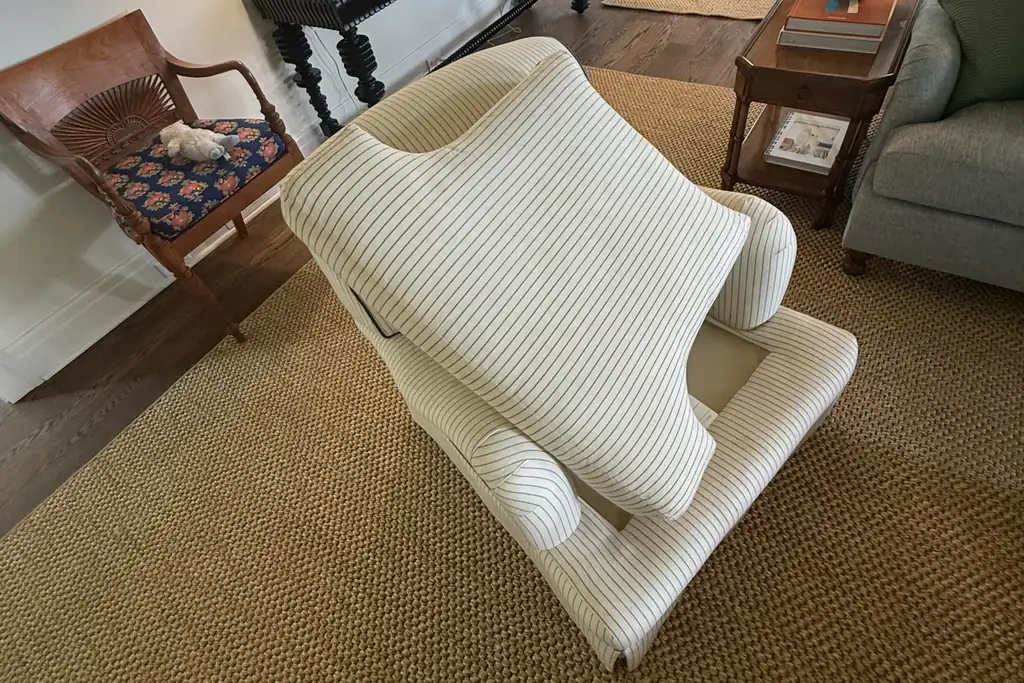
Clearing the work area. The armchair sat partly on the stained area, so it was tipped back off the rug rather than dragged. Dragging furniture across jute pulls on the weave. Lifting does not.
Dry soil out first. Before anything wet touches jute, the area gets a thorough vacuum. A basket weave collects grit in every opening, and grit turns into mud as soon as you add liquid.
Spot work. Each stain is treated on its own with a mild cleaning solution made for natural fibers. It gets time to work, and then the spot is blotted and extracted with as little water as possible. That is slower than running a wand over carpet. It is supposed to be. We work from the outside edge of each spot inward, so the stain does not spread into a bigger ring.
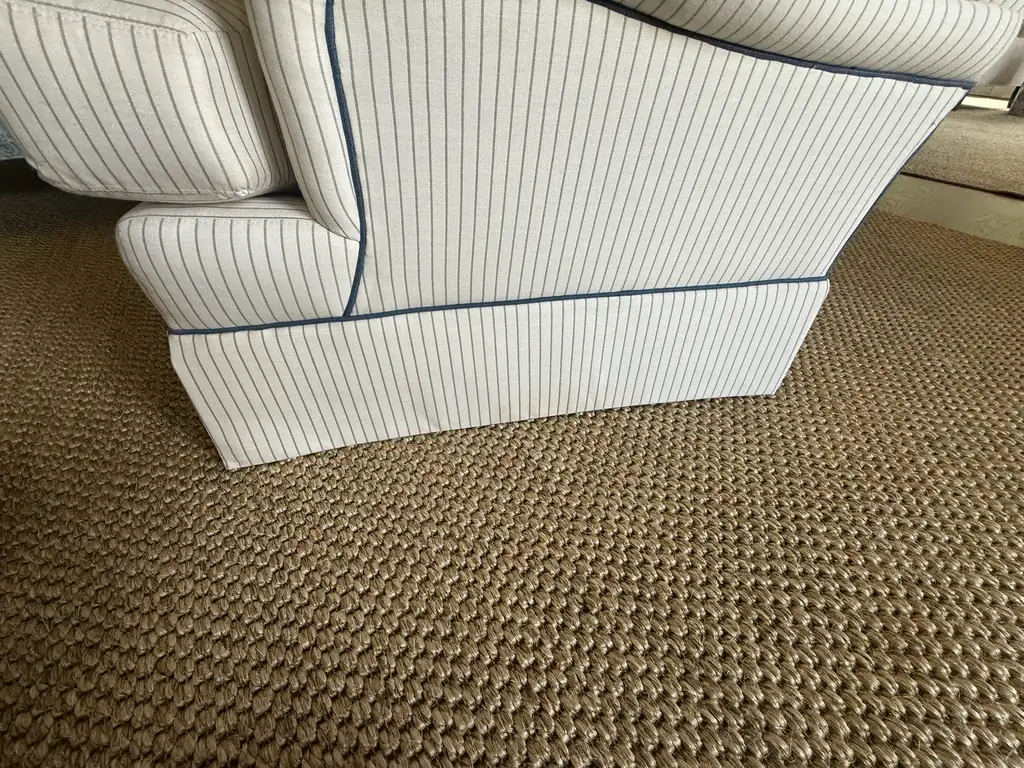
The close-up above shows why jute is hard to clean. Every one of those raised loops is a small bundle of stiff plant fiber, with gaps between them where soil and spills collect. Scrub across that surface and the loops fray. A gentle, controlled method keeps the texture looking the way it did when the rug was new.
2:55 PM. Spots treated, pillows done, an air mover running on the rug, and the job marked finished.
What about the throw pillows?
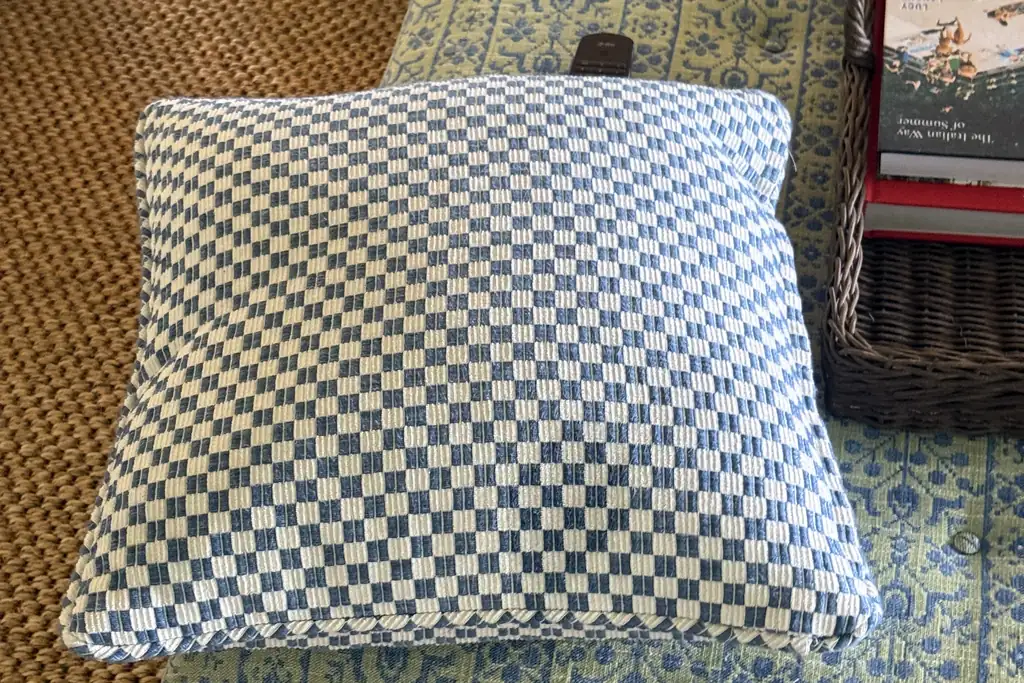
Pillows are the easiest thing in a living room to forget and the first thing to pick up skin oils, hair products, and hand grime. These two were cleaned on the same visit, so they did not need their own appointment.
Before any upholstery gets cleaned, we look for the cleaning code on the tag. W means water-based cleaning is fine. S means solvent only. W/S allows either, and X means vacuum only. If there is no tag, we test the fabric somewhere hidden first. Woven checks like the blue-and-white pattern above can bleed if they are over-wetted, so the test is not optional. This follows the inspection-first approach in the IICRC S300 standard for professional upholstery cleaning.
The same checks apply to sofas, sectionals, and dining chairs. If the pillows are dirty, the furniture they sit on usually is too. Our upholstery cleaning page explains how we handle full pieces.
Why does drying matter more than cleaning on jute?
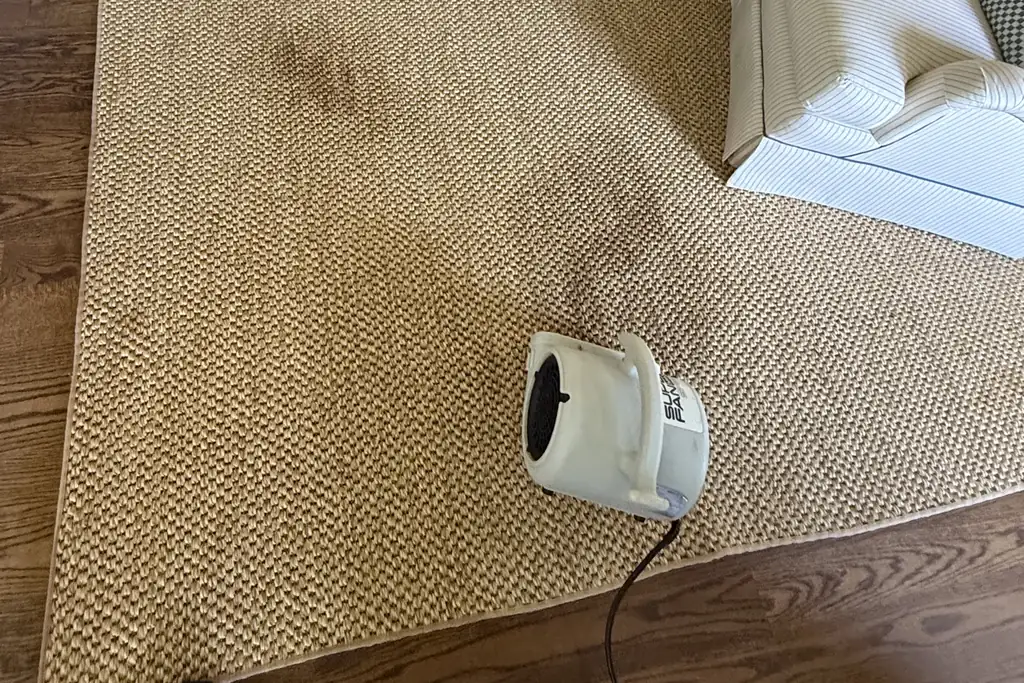
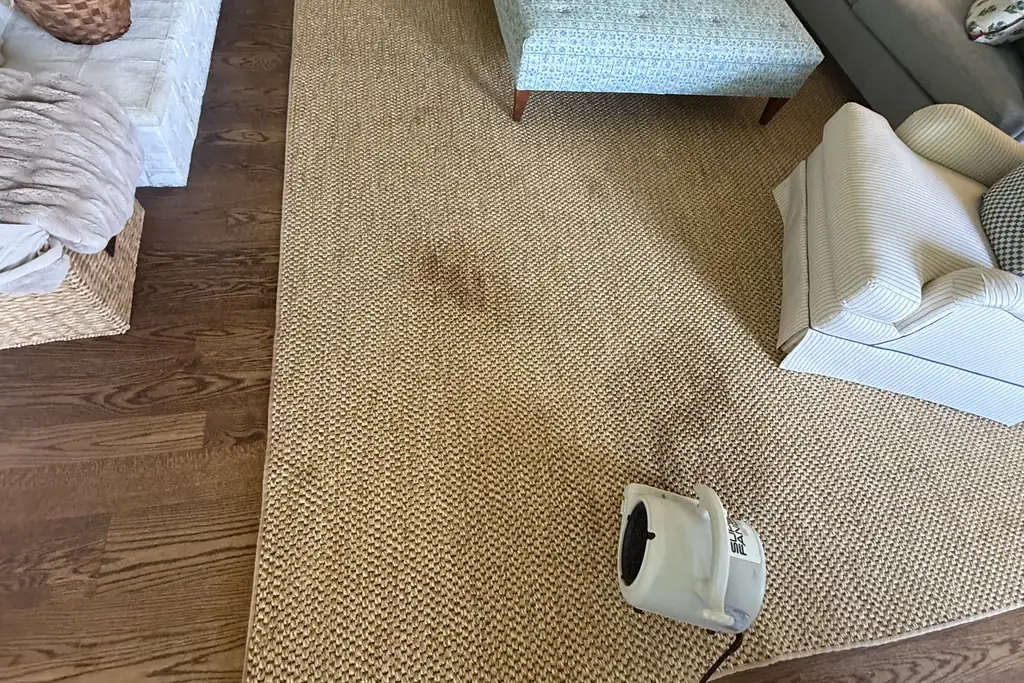
Here is the rug right after the spot work, with an air mover aimed across the treated area. (The photo at the top of this post shows the same moment from further back.) The darker patches you see are the cleaned spots, still damp. Plant fiber always looks darker wet than dry.
On synthetic carpet, slow drying is an inconvenience. On jute, it causes damage. Browning comes from moisture sitting in the fiber long enough for those natural compounds to wick up, so the faster the treated area dries, the lower the risk. That is why the air mover was there and why we leave drying instructions:
- Leave the air mover or a box fan blowing across the rug, not straight down on it.
- Run the AC or open a window if it is humid outside. September in the northwest suburbs can still be sticky.
- Keep the furniture off the treated area until it is dry to the touch. Wood or metal feet on damp jute can leave rust or tannin marks.
- Walk on it in socks if you have to. No shoes, no pets running laps.
So what does this actually cost?
We would rather show real numbers than say "it depends" and stop there. Here is this job alongside two others from the same month and our published prices:
| Job or service | Price |
|---|---|
| This job: jute rug spot cleaning, organic stain removal, 2 throw pillows (Barrington) | $220 |
| Minimum for any visit in the suburbs | $180 |
| Full area rug cleaning at our facility, free pickup and delivery | from $3 per sq ft (synthetic), from $5 (wool) |
| Example: full cleaning of an 8×10 rug (80 sq ft) | about $240–$400, depending on fiber and condition |
| Upholstery cleaning (sofas, chairs, sectionals) | $40 (chair) to $180 (sectional) |
| Upholstery spot treatment only | from $49 |
| Glenview: 2 carpet traffic paths, 3 kitchen rugs, 1 sofa, protector (Sep 23) | $210 |
| North Center, Chicago: 4 rooms of carpet plus a CRB scrub (Sep 28) | $330 |
Two things stand out.
The price follows the work, not the number of items. The Glenview visit covered more items and cost less than this one. Traffic-path carpet cleaning and small kitchen rugs go quickly with the truck-mounted machine. Spot work on jute is slow, careful handwork with no shortcuts. An hour of that work costs what it costs, whether it is spent on a rug or a sofa.
Spot cleaning was the cheaper choice here, and the safer one. Washing a large living-room jute rug at our facility would have meant pickup, a full wash with browning control, and a long, managed dry, at several times the price and with more moisture going into the whole rug. When a rug is clean except for a few spots, cleaning just the spots is the right call. We would say so even if it meant a smaller invoice.
For a bigger job, our $330 North Center invoice breaks down what a multi-room carpet job includes line by line. For a quick estimate for your own home, the online price calculator takes about a minute.
What else did we clean that month?
Rugs and upholstery on the same visit is more common than most people expect. Three weeks after this job we did a carpet and upholstery cleaning project in Glenview with a similar mix. It had plush carpet with worn traffic paths and pet urine spots, a polyester-blend sofa with water rings, and three small kitchen rugs, all cleaned in one trip and finished with carpet and fabric protector.
That project page has before-and-after photos and the full scope of work. The water rings on that sofa are a good reminder of the same lesson as the jute: too much water, drying unevenly, leaves a mark. Whether it is a rug or a cushion, how much moisture goes in and how fast it comes out decide most of the result.
From our side: what would we tell any jute rug owner?
These come from years of answering the same call. None of them cost anything.
Call before you scrub, not after. The hardest jute jobs we see are not the original spills. They are the attempted fixes: a bleach-based spot remover that left a pale halo, a carpet shampooer that turned one small stain into a brown ring the size of a dinner plate. A fresh stain is a simple job. A stain someone has already worked on is a repair.
Put a pad under it. A rug pad keeps air moving beneath the rug, so any spill dries from both sides instead of sitting on the hardwood. It also stops the rug from shifting, which is what wears down the weave in walkways.
Ask every cleaner how they will dry it. If the answer for jute is steam cleaning, a full wet shampoo, or "it'll be dry by tomorrow," find someone else. The right answer mentions low moisture, a gentle solution, and moving air.
When can you handle it yourself?
Often. If the spill happened in the last few minutes, this is what to do before calling anyone:
- Solids first. Scrape up anything solid with a spoon or a dull knife. Let mud dry completely, then vacuum it out of the weave.
- Blot, do not rub. Press a clean white towel onto the spill and lift straight up. Keep going until the towel comes up dry.
- Barely damp, never wet. If a mark is left, dampen a cloth with plain water, or water with a drop of clear dish soap, and blot again. Then blot with a dry towel to pull the moisture back out.
- Dry it fast. Point a fan or a hair dryer on its cool setting at the spot until it is fully dry.
Cornell Cooperative Extension's home stain guide says the same thing in four short rules: test first, do not overwet, blot frequently, and do not rub. On jute, those rules are the difference between a spot that disappears and a spot that becomes a ring.
When to stop and call: the stain is old and dark, it is pet urine, it covers a large area, or a brown ring has already appeared after a DIY attempt. That last one gets worse with every try, so the sooner it is looked at, the better.
Questions we get about jute rugs
Can a jute rug be professionally cleaned?
Yes, but it should not be steam cleaned or soaked like carpet. Jute is a plant fiber that can brown, shrink, or ripple when it gets too wet. For a jute rug that is clean except for a few spots, low-moisture spot cleaning in your home with fast drying is usually the safest option. A heavily soiled jute rug can be washed at a facility that uses browning control and controlled drying.
How much does jute rug cleaning cost?
The job in this article, spot cleaning organic stains on a large jute rug plus two throw pillows, cost $220 in Barrington, IL. Our minimum for a suburban visit is $180. A full off-site hand-wash is from $3 per square foot for synthetic rugs and from $5 for wool with free pickup and delivery, so an 8x10 rug is roughly $240 to $400 depending on fiber and condition.
Why does my jute rug have brown spots after I cleaned it?
That is usually cellulosic browning. When jute stays wet too long, natural compounds in the plant fiber move to the surface as it dries and leave yellow or brown marks. Too much water, alkaline cleaners, and slow drying all make it more likely. It often shows up only after the rug is completely dry, and repeated DIY attempts tend to make the ring bigger.
Can you clean throw pillows and a rug in the same visit?
Yes. On this job two throw pillows were cleaned during the same visit as the jute rug, at no extra trip cost. We check each pillow's cleaning code (W, S, W/S, or X) or test the fabric in a hidden spot first, because woven patterns can bleed if they are over-wetted.
How long does a jute rug take to dry after spot cleaning?
Spot-cleaned areas on jute usually dry within a few hours when an air mover or fan is blowing across the rug. Keep furniture off the treated spots until they are dry to the touch, run the air conditioning on humid days, and keep shoes and pets off the damp areas.